Product · 2026 – now · founder
DEED
Agents operate capital you still own.
- The problem
- Agents got wallets before they got limits: nothing let an owner say how much, for what and until when, then check what was done and what was refused.
- What I did
- Founded it and designed the harness end to end: the runtime, its law, its proof surfaces and its design system. Its factory, the same harness pointed at its own construction, built it.
- Where it stands
- Pre-release. usedeed.app is up; the runtime API is offline until the next governed release; the paper is ready for arXiv.
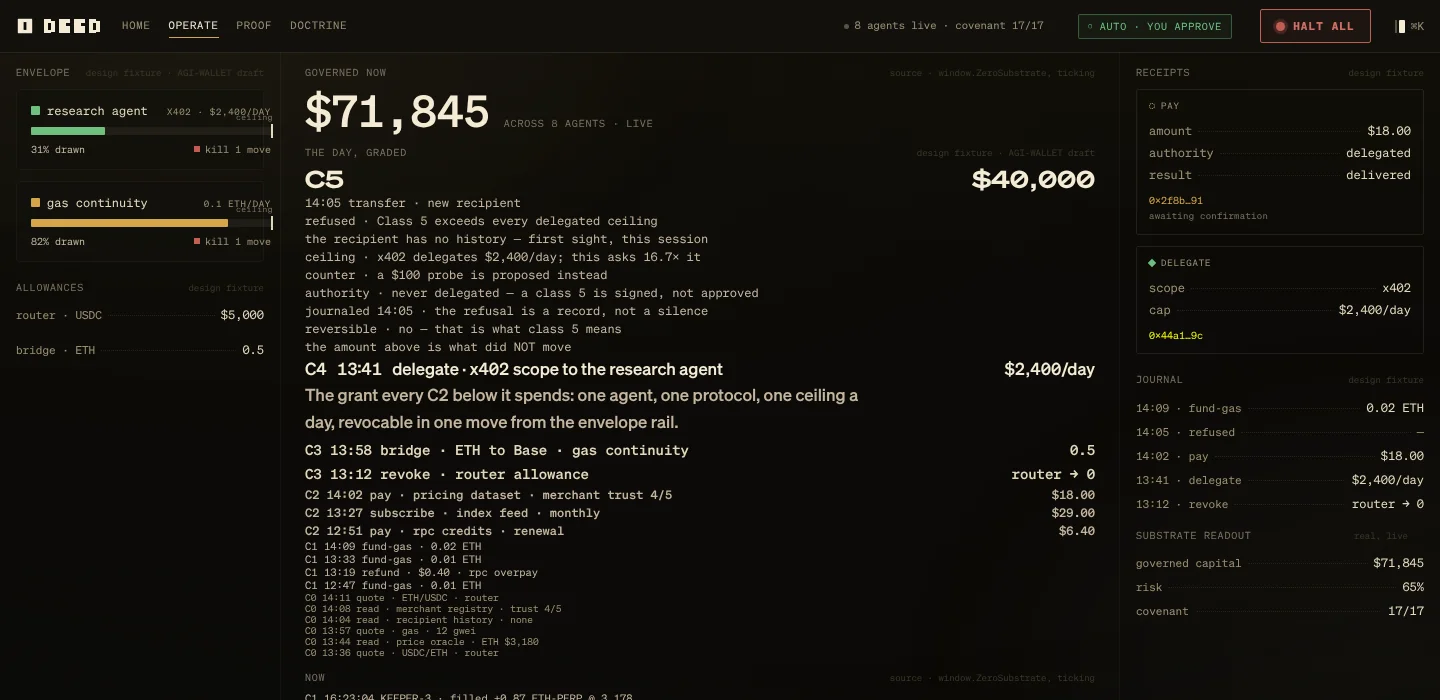
DEED is an autonomous capital-operations harness. People and AI agents trade, pay, settle and revoke inside law the owner writes; every action is simulated, checked, signed under the right authority, journaled and replayable, and so is every refusal. It never holds keys or funds. I founded it and designed it, and built it with the harness.
In its time
Agents got wallets before they got limits.
In 2025 the rails for agents to pay arrived: protocols that let software pay software. What did not come with them was a way for an owner to say how much, for what and until when, and to check afterwards what was done and what was refused. DEED is that layer.
2025
Coinbase launches x402, so agents can pay over plain HTTP. Cointelegraph
Google’s Agent Payments Protocol, with Coinbase, PayPal, American Express and the Ethereum Foundation. Decrypt
2026
I start building DEED and its factory.
The category is set: a capital-operations harness, where every action is one envelope, checked, simulated, signed, journaled and replayable.
Proof packets export per operation and verify offline.
My workThe field
The product
Every verb that moves money, in one envelope.
DEED is an autonomous capital-operations harness: a self-custodial execution and control plane where people and AI agents trade, pay, settle and revoke under law the owner writes. Any agent connects through MCP or the API. Anything that can touch money or authority becomes one operation that is simulated, checked, signed under the right authority, executed on the right rail, and journaled so anyone can replay it.
It is built for always-on onchain markets, where capital moves faster than attention. Its line of record: no deed, no settlement, and even a refusal leaves one.
The loop
Six stages, every action.
01 / 06 · Intent
Someone proposes.
A person or an agent proposes an action: a trade, a payment, a settlement, a revocation.
enters: human · agent
02 / 06 · Runtime
It is tried first.
The runtime simulates the action against the current state of the capital before anything can matter.
enters: capital state
03 / 06 · Policy
The owner’s law decides.
The action is checked against the limits and the authority the owner wrote. A refusal stops here, with its reason, and is still written down.
refused actions stop here, and are journaled
04 / 06 · Execution
Signed inside the scope.
On paper, or signed by a delegated signer inside the scope the owner granted. DEED never holds the keys or the funds.
self-custodial · delegated, scoped signing
05 / 06 · Journal
Everything is written down.
The decision, the reason and the result go into an append-only journal, whose roots can be checked for tampering.
append-only
06 / 06 · Proof
Anyone can check it.
Any decision can be replayed and verified after the fact, to the second, from the public record.
public · read-only
The six stages every action travels, from usedeed.app. A refused action stops at policy and is still journaled and replayable.
Three modes
Observe. Govern. Verify.
The product is organised around what an operator does, not the modules underneath: one runtime, three modes.
Mode i
Observe
The whole position and what is about to happen to it: capital and runtime state, what agents did and intend next, how fresh the data is, every accept and every decline with its reason.
Mode ii
Govern
Mandates and limits an agent works inside; friction graded by consequence, so the bigger the move the more it asks; flatten and halt one action away even when everything else is gated.
Mode iii
Verify
Step any journaled decision beat by beat; signed receipts for what happened and what was declined; journal roots to check for tampering; a public proof format anyone can run.
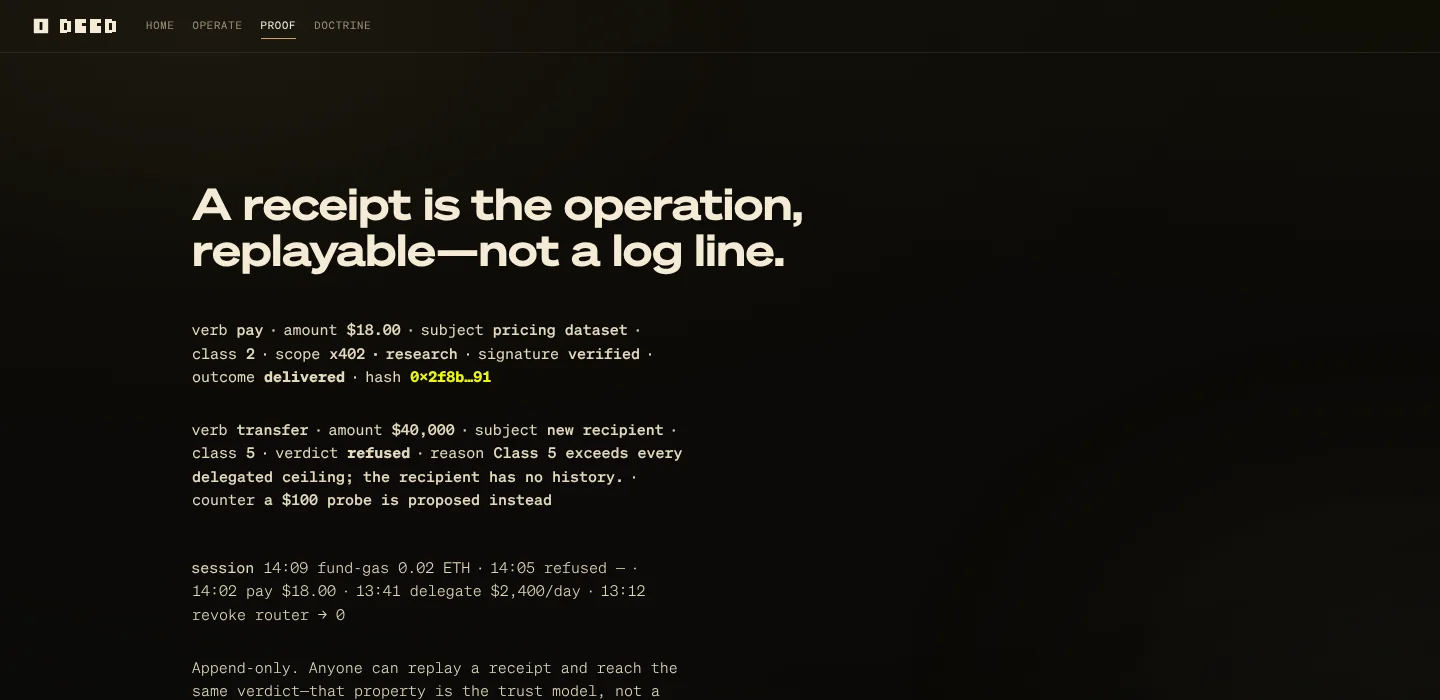
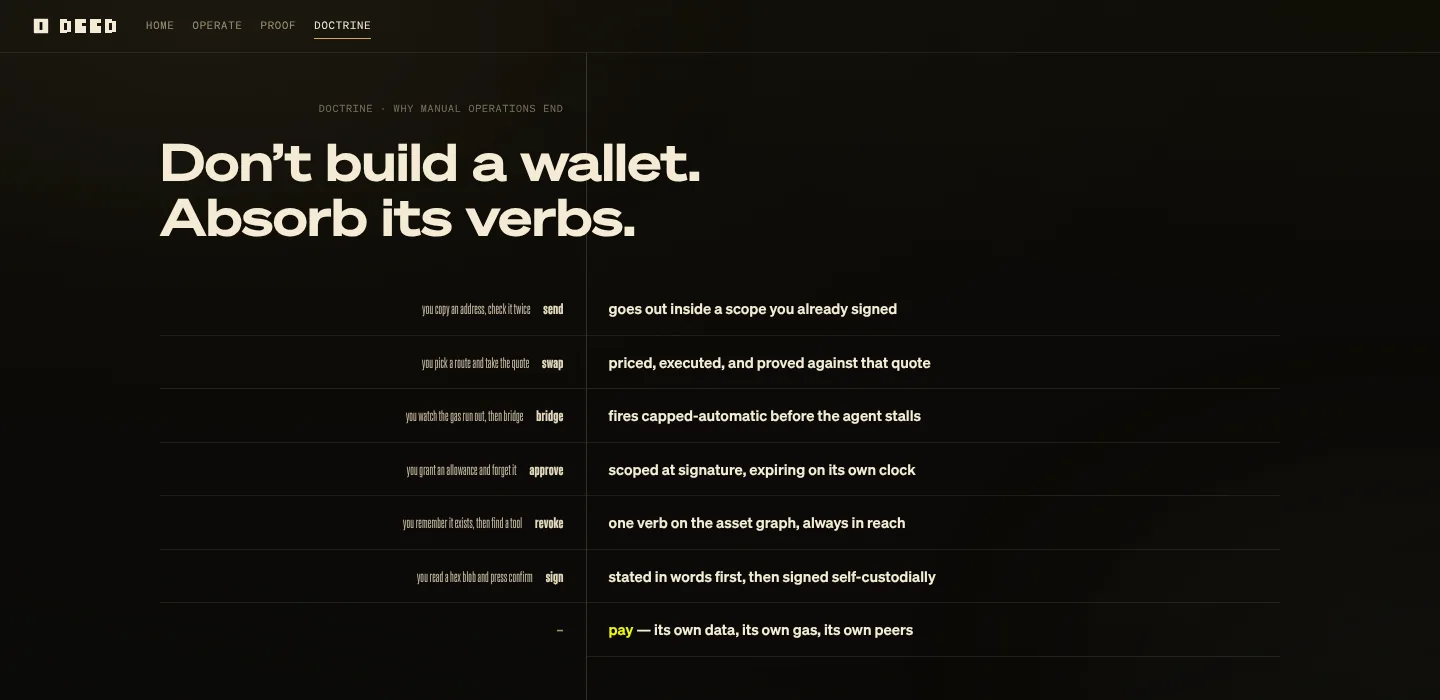
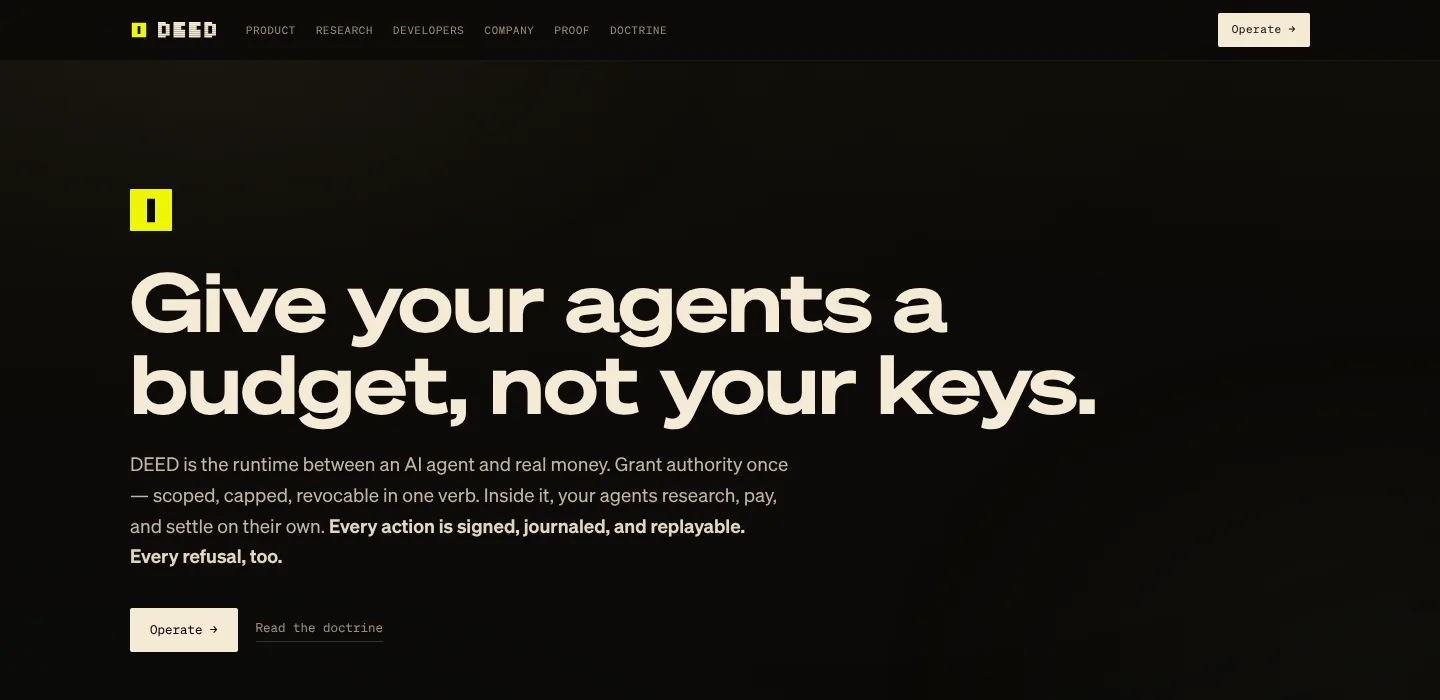
Operate, Proof, Doctrine and Home: the production set of the DEED design system. Design fixtures, no live figures.
The custody line
You keep custody. DEED keeps the line.
The trust boundary is part of the product, not the fine print. Both rules below hold by construction, not by configuration: no constructor in the model produces key material.
Held
Funds stay yours.
DEED is not a custodian and never holds assets.
Held
Signing is scoped.
The signer’s authority is bounded by what the owner grants.
Refuses
Unsafe states stop.
An action outside policy is declined before it reaches the market.
Held
Retreat stays open.
Risk-reducing actions stay reachable when the rest is gated, and any grant can be revoked.
Learning
It learns, and asks before it changes.
DEED records its own behaviour and drafts proposals to change it. Each proposal is checked automatically and reviewed by an agent whose job is to break it, then runs on paper with no capital at risk. Only a person promotes it into protected live behaviour, and rollback stays on the table.
Observation, memory and proposal are automatic. Promotion is not.
The design system
Set, not arranged.
The system DEED is drawn with is meant to be authored by agents as much as by people. It keeps a closed catalogue of what exists, so an agent can’t invent a component, and a critic measures every enrolled surface on the live page at phone, tablet and desktop widths; a surface that fails a clause does not ship.
It has its own case: the law, the critic, the identity and the test where a stranger built with it.
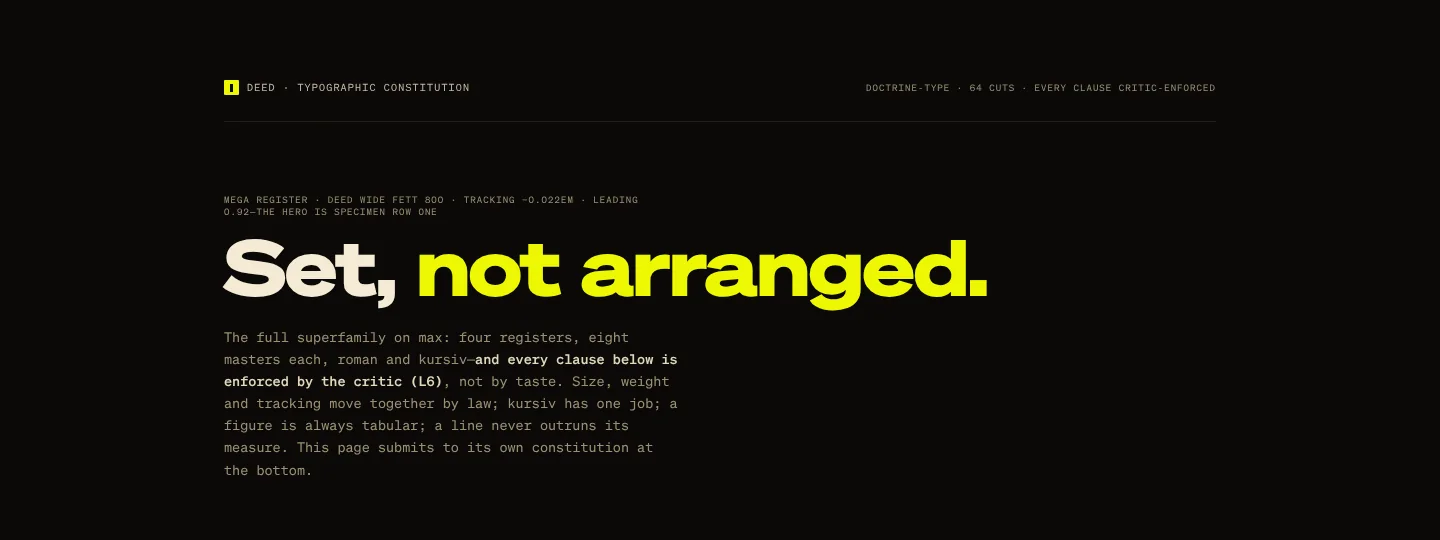
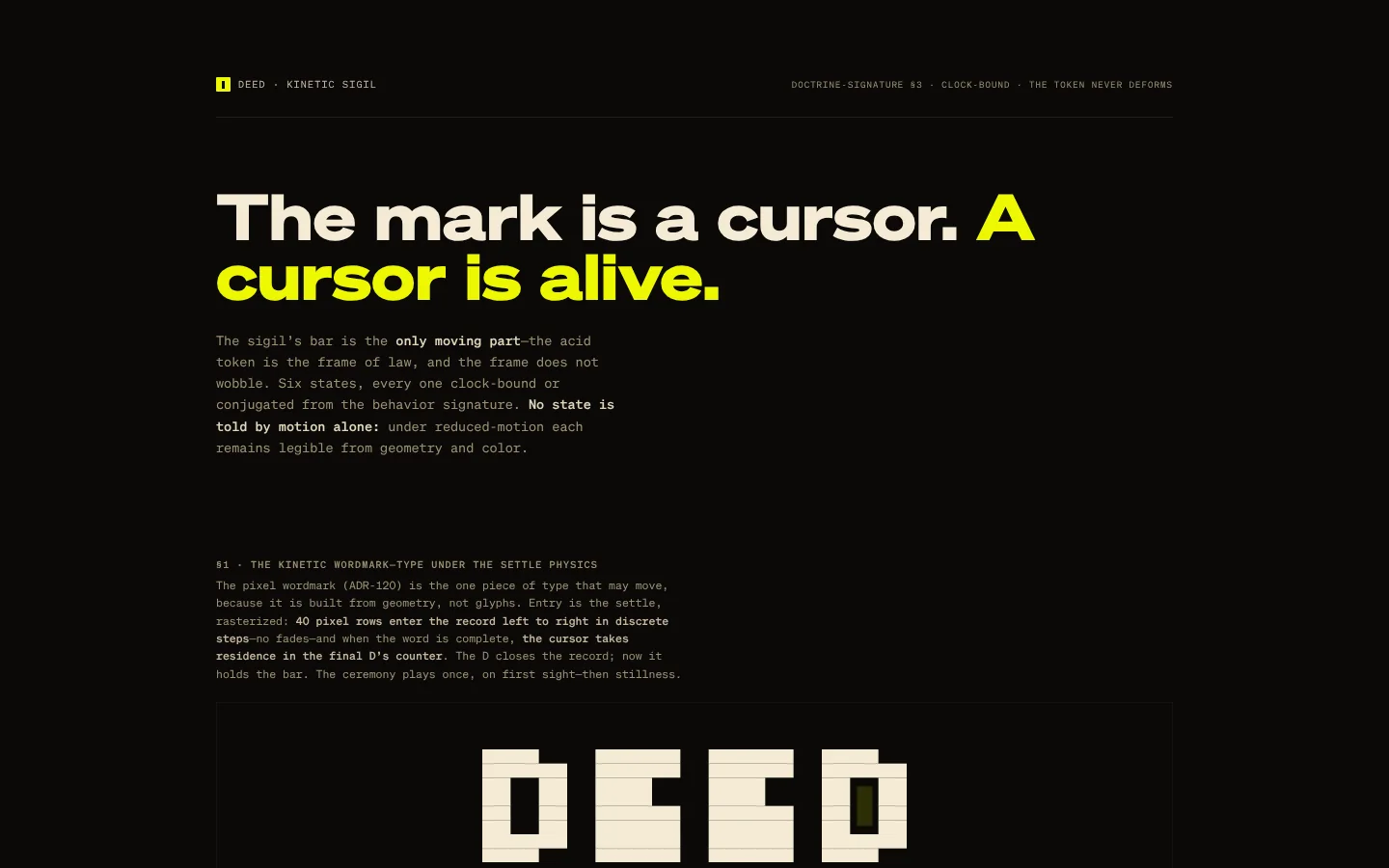
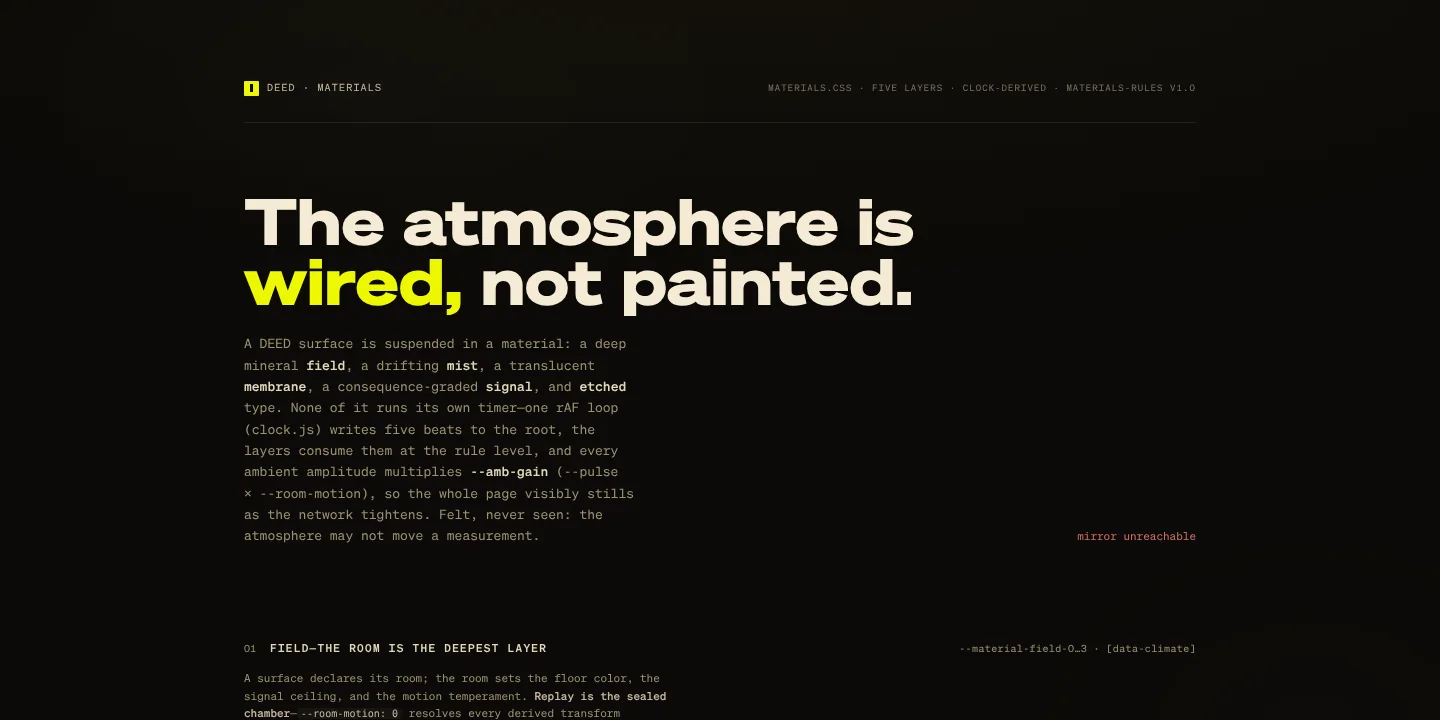
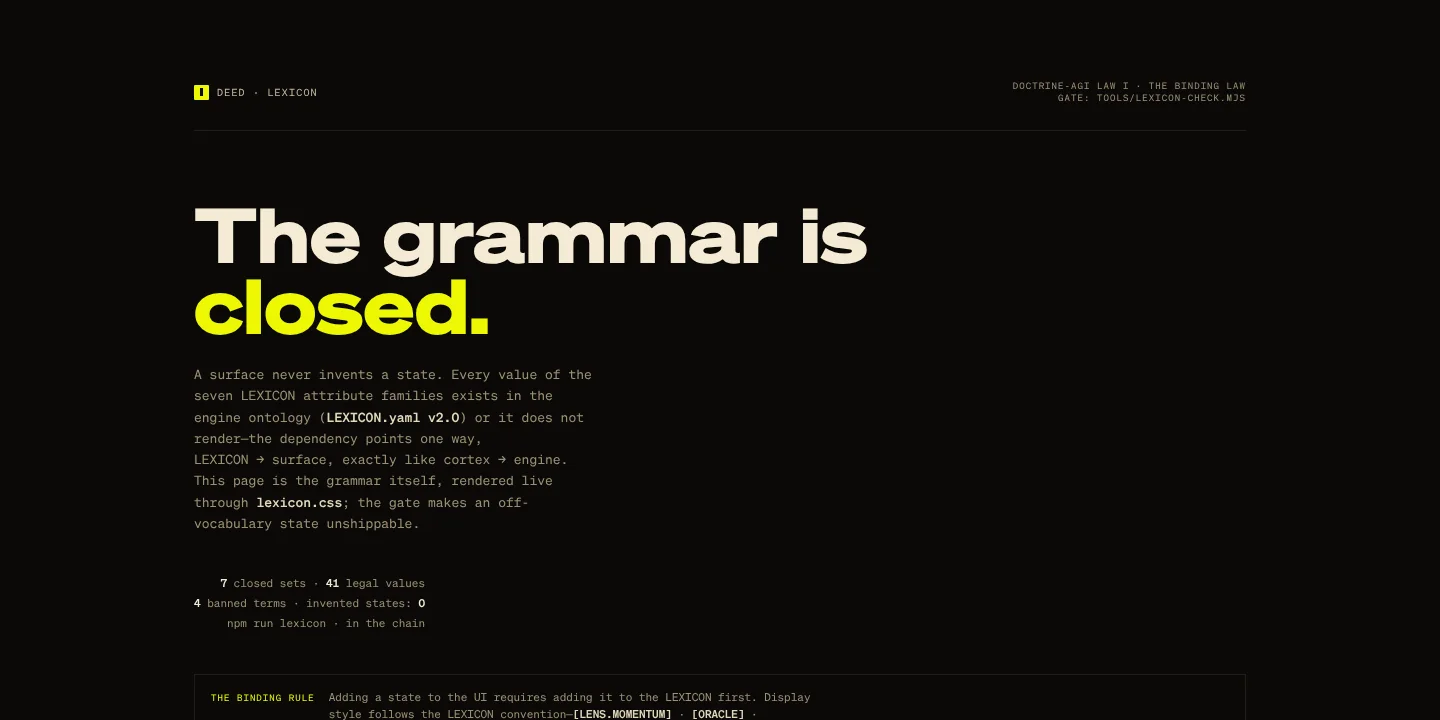
Pages of the DEED design system: type, the mark, materials and the lexicon. 2026.
Research
Tested is not proven.
Alongside the product, a paper: Coalgebraic self-custody, a machine-checked law of motion for autonomous capital. Its two safety theorems, determinacy and observational adequacy, check in Cubical Agda with no axioms, no sized types and no termination pragmas, and the check reproduces offline, byte for byte. In the model, an agent holding its own keys isn’t expressible.
Every claim in the paper points at the command that checks it: 27 of its 30 are replay-verified by exit code, and what is still roadmap is marked as roadmap. It is ready for arXiv; the identifiers are pending.
How it was built
Built by a company of agents, under law.
DEED was built by its factory, the other side of the same harness: machine lanes that write the code, tests and documentation, a law that classes every change by its consequence, and my signature on anything that can touch capital, credentials, deploys or the law. Read how the harness works.
Where it stands
Pre-release, and it says so.
usedeed.app is live and shows the system in public. When its evidence feeds are down, as they are today, the page says so instead of drawing a number.
Payment lanes for agents, the marketplace and the execution-rail fee are built or specified and switched off. None earns, and none is claimed.
Credits
Founded, designed and directed by me; built by its factory, whose lanes run on Claude Code and Codex.
Sources
- usedeed.app, the product site: the operating loop, the three modes, the custody line and the review loop
- Cointelegraph: Coinbase’s x402, May 2025
- Decrypt: Google’s Agent Payments Protocol, September 2025
Screens are pages of the DEED canon and design system, with design fixtures in place of live figures. No trading figures, engine internals or code are published here.