System · 2026 – now · founder and designer
DEED design system
A design system that judges its own work.
- The problem
- Agents write most of DEED’s interface, and a style guide a model reads once is advice it can forget.
- What I did
- Designed a design system a machine can enforce, and directed the agents that built it: the identity, type, motion and sound, a catalogue of 229 components, and automated checks that refuse work which breaks the rules.
- What happened
- 281 releases in 67 days. A critic checks every page at three widths, and an agent with no context built a screen that passed every check from the public docs alone.
The DEED design system is the set of rules DEED’s interface is made under, written so a machine can enforce them: a catalogue of every component, rules a script can check, a critic that measures the rendered page, and docs and tools an outside agent can build with. I designed it and directed the agents that built it.
- numbered releases
- 281
- in 67 days, about four a day
- design system changelog, private
- catalogued components
- 229
- 200 of them pass its own quality bar
- catalog.json, private
- automated checks in one chain
- 23
- each tested against a defect planted for it
- package.json, private
- rules the critic measures
- 13
- on 36 pages, at three widths each
- critic.js 1.5, private
In its time
Agents started reading design systems. Most were written for people.
By 2025 a model could read a page about a design system and build from it. Guidance a model reads once is advice; a design system had to become something a machine can check.
2024
llms.txt is proposed: a plain file that tells a model what a site contains. The Decoder
2025
Figma opens its design files to agents through an MCP server. AlternativeTo
2026
Version 1.0 of the DEED design system: tokens, type and the first catalogued primitives.
The critic checks every page at three widths; an agent with no context builds a passing screen from the public docs alone.
Version 3.171, the 281st numbered release.
My workThe field
The rules
Advice is ignored. Rules can refuse.
Agents write most of DEED’s interface. A style guide a model reads once is advice it can forget, so I wrote the system as rules a machine can run. Everything that exists is in a catalogue: 229 components, each with its states, its properties and a quality score. If it isn’t in the catalogue, an agent can’t use it.
The rules are short. Tokens only, never a raw value. One acid-yellow signal per screen. Amber, the colour of agents and the operator, on at most 7% of it. Two-pixel corners. Motion only when something changes state. A number that hasn’t arrived shows a placeholder, never a made-up figure.
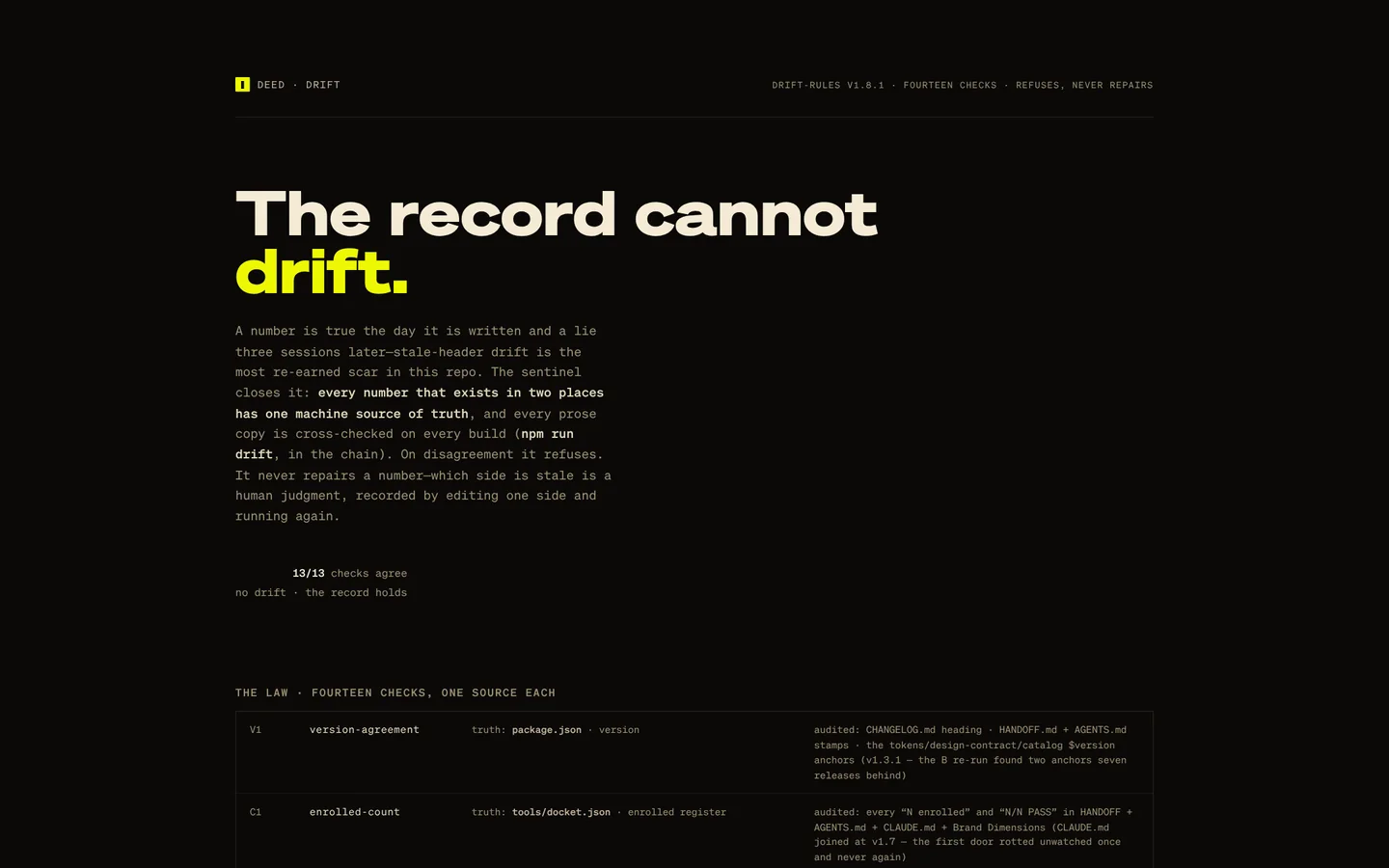
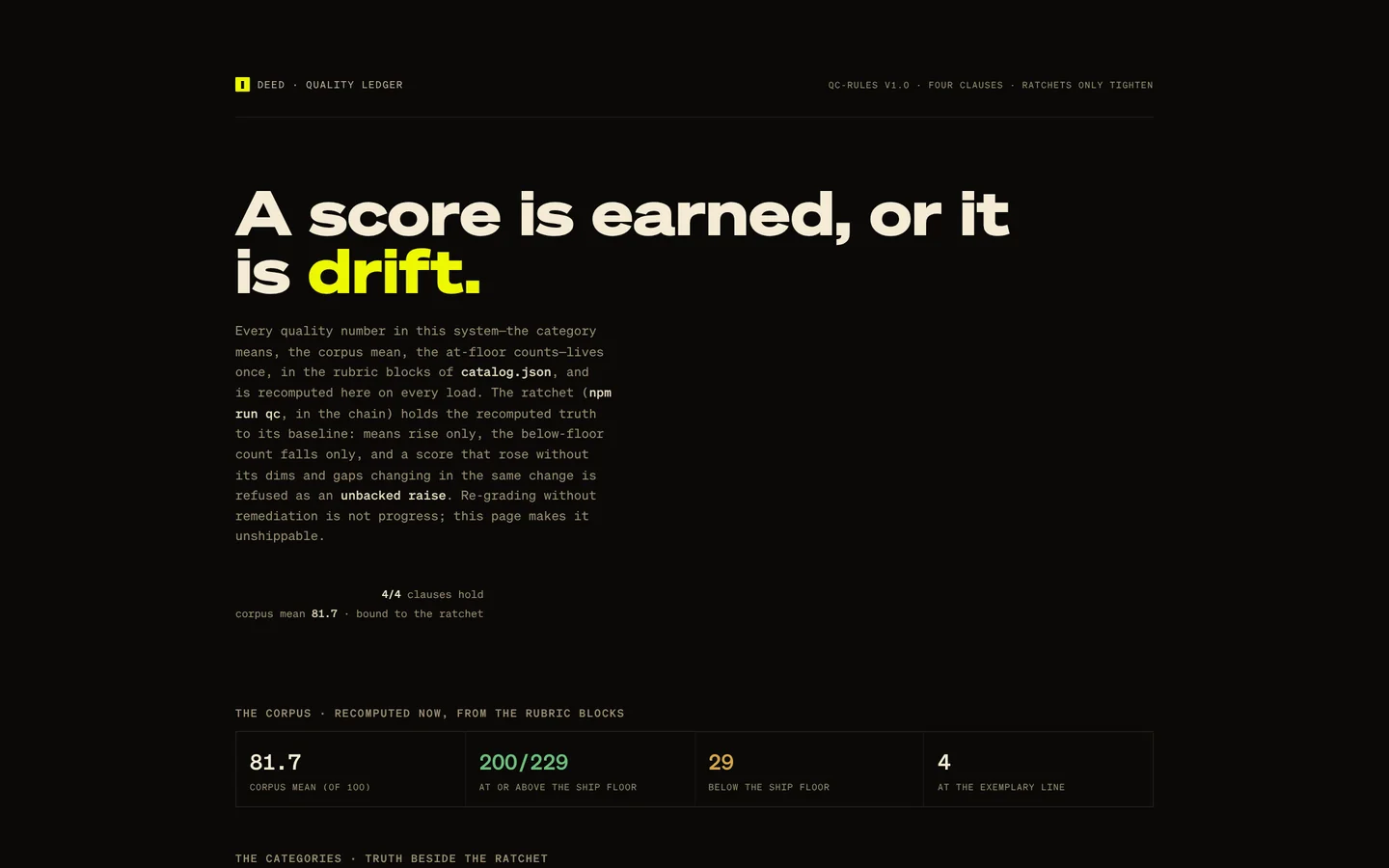
Three of the system’s own pages: the critic, the check that keeps the docs in step with the code, and the quality ledger. Each is enforced automatically.
The critic
The system checks itself.
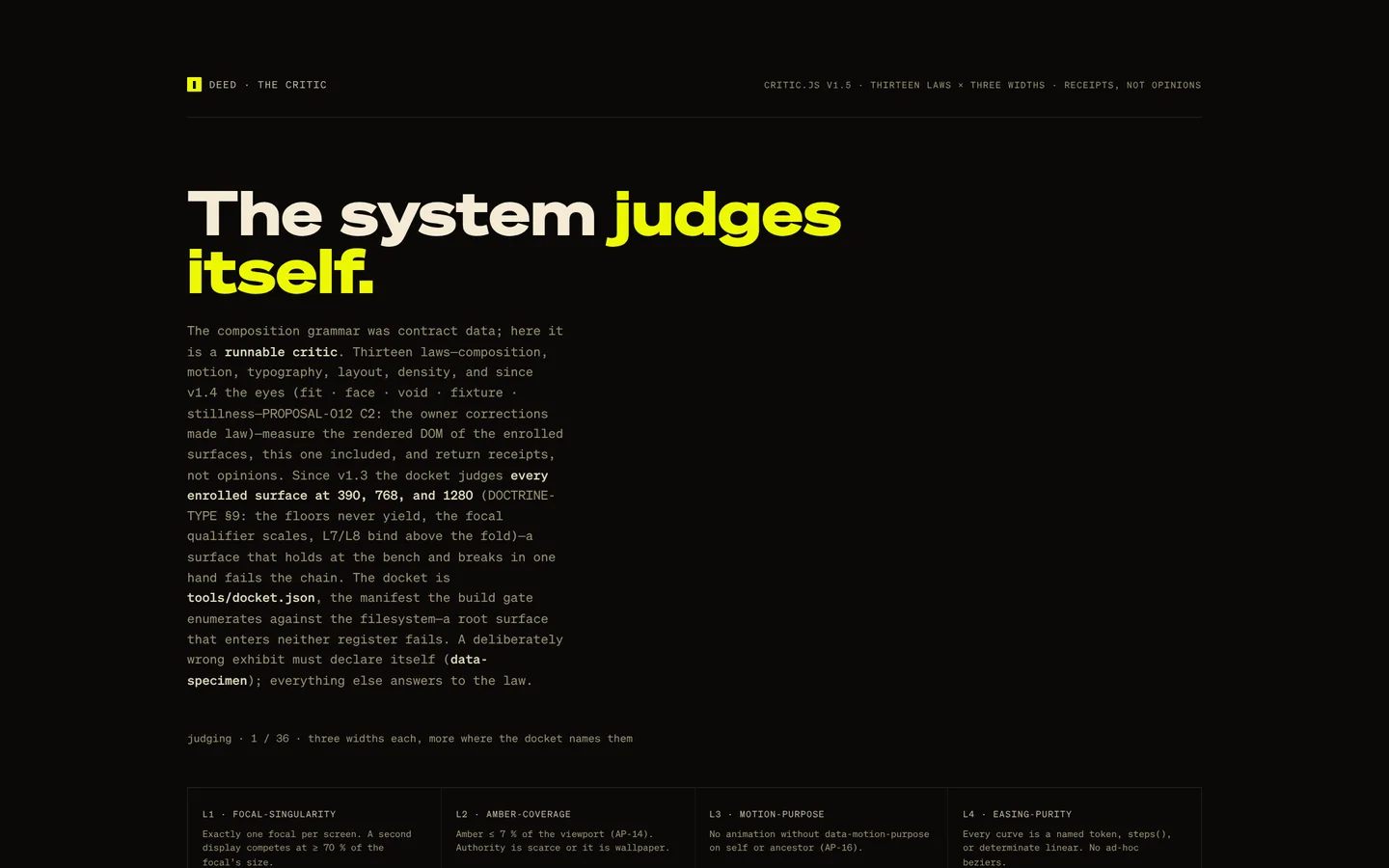
A critic measures thirteen rules on the rendered page, not the source, at 390, 768 and 1280 pixels: one focal point per screen, the amber budget, motion with a purpose, contrast, fit. Thirty-six pages are checked and four are exempt, each with a written reason. Every pass is tied to the exact file it judged, so changing a page voids it.
Twenty-three checks run in a chain before anything counts as done, and the first one tests the others: each must still catch a defect planted for it, or the chain is not trusted. Every number in the docs comes from one machine source, so a stale count fails the build.
The identity
A cursor that settles.
The mark is a cursor, and its bar is the only part that moves. Motion has three verbs: settle, land and refuse. Nothing bounces. Sound is the same cursor heard: one root at 110 hertz, whole-number harmonics only, off until you turn it on.
Type is Söhne in four cuts. Weights step between eight licensed masters and are never interpolated.
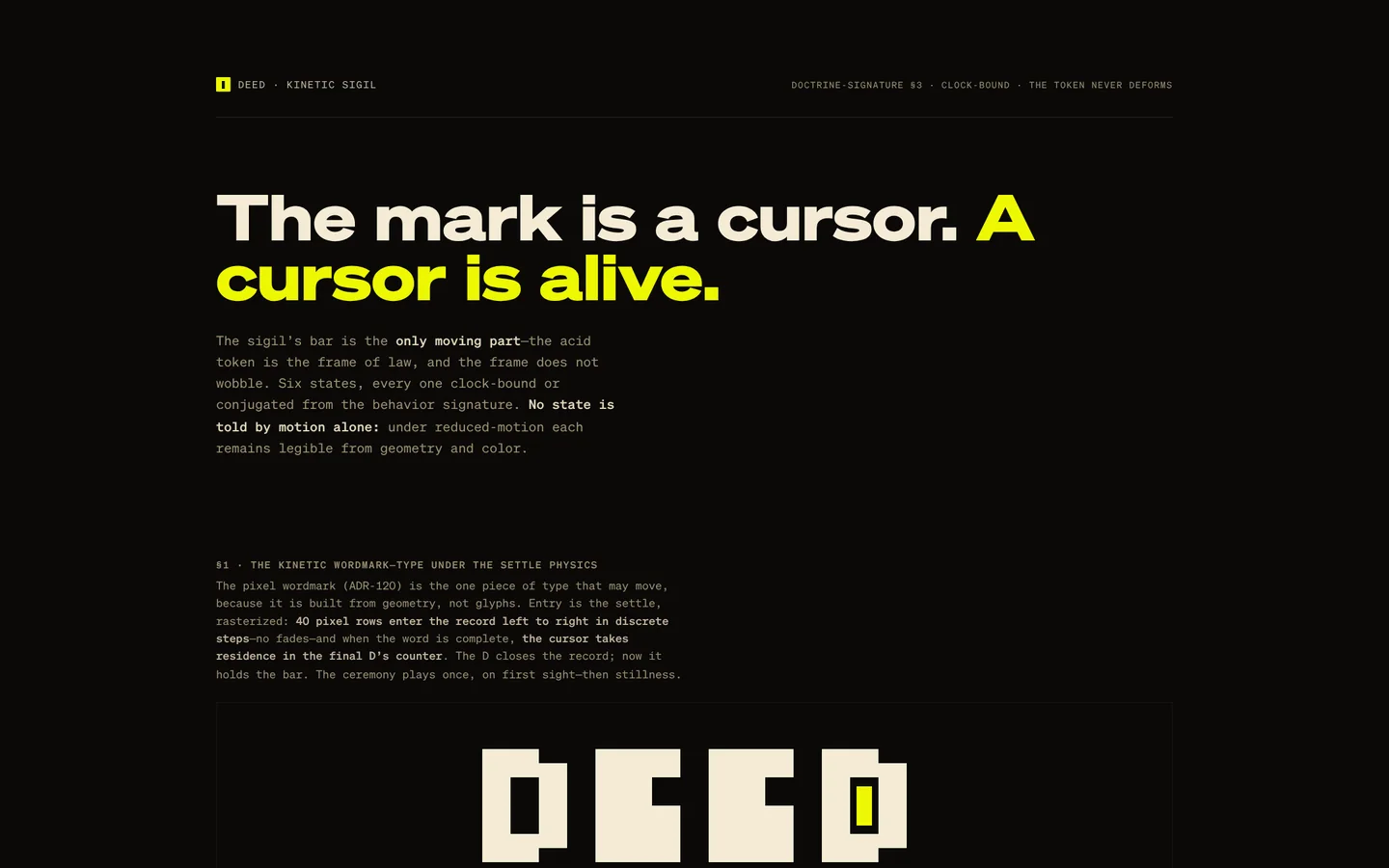
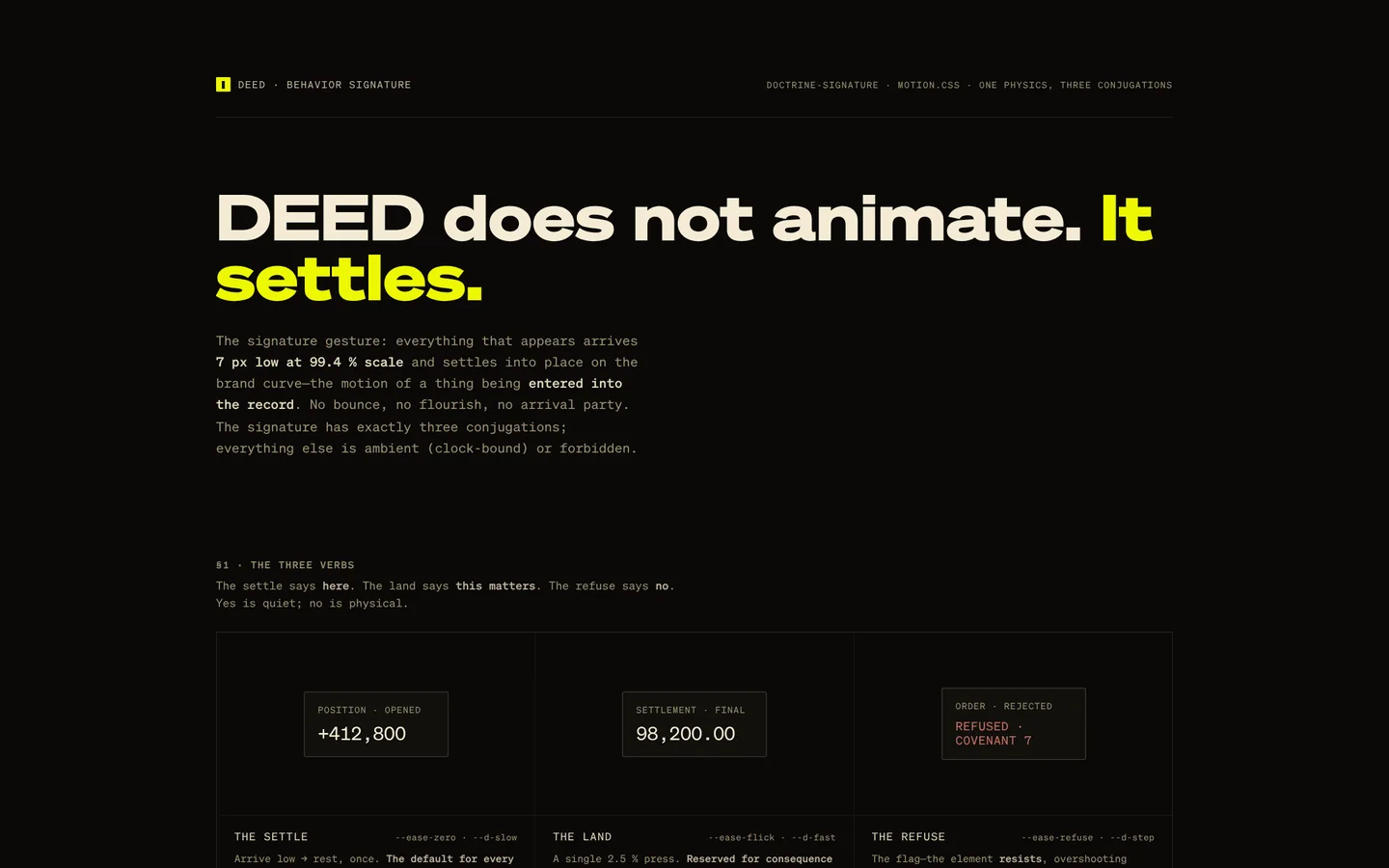
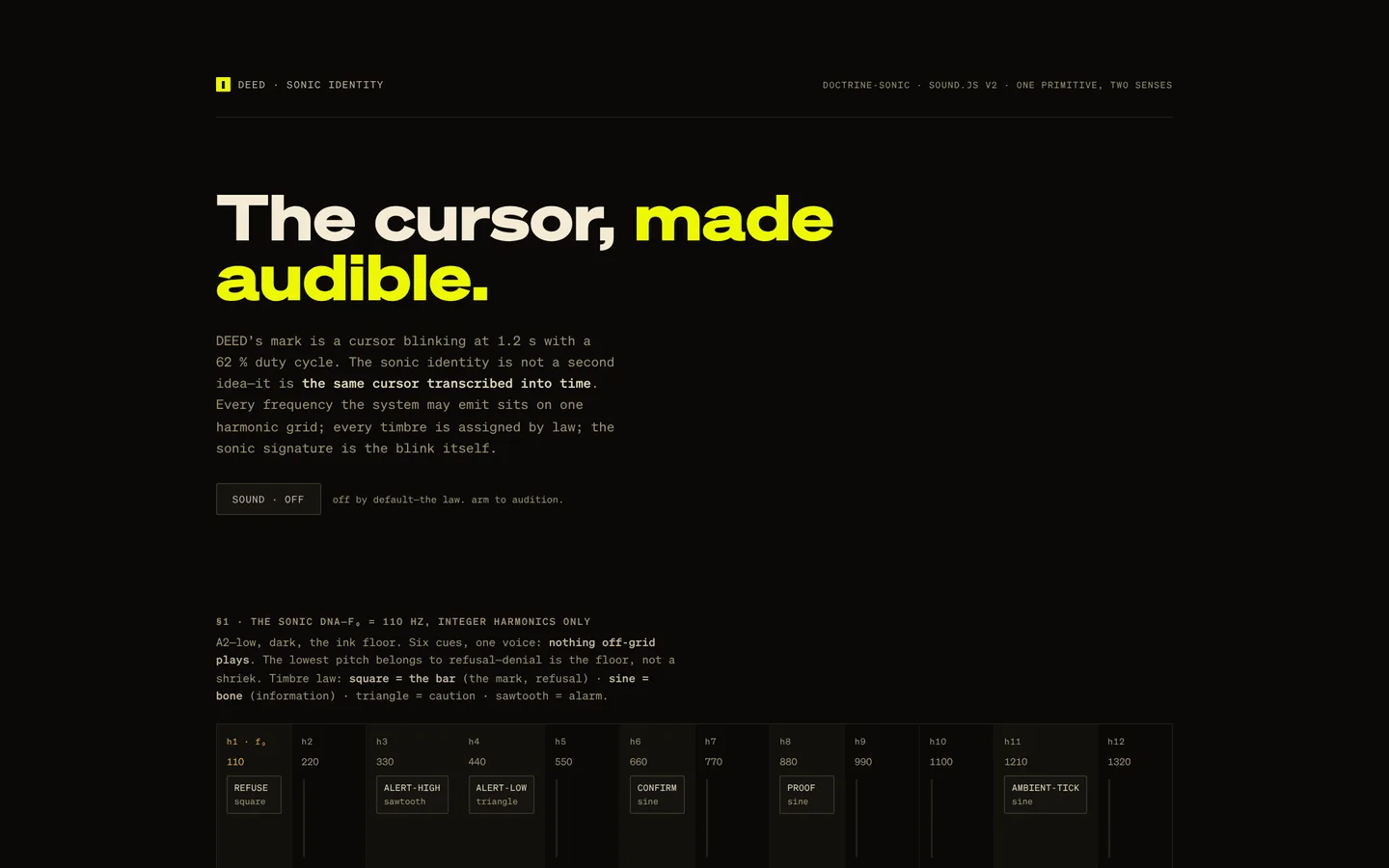
The mark, motion and sound pages, each with a live demonstration on the page.
The surfaces
Thirteen volumes, one grammar.
A manual in thirteen volumes, from capital and governance to memory and accessibility, shows every component at work. Each chart answers one question, inside a frame that names its source and how often it updates.

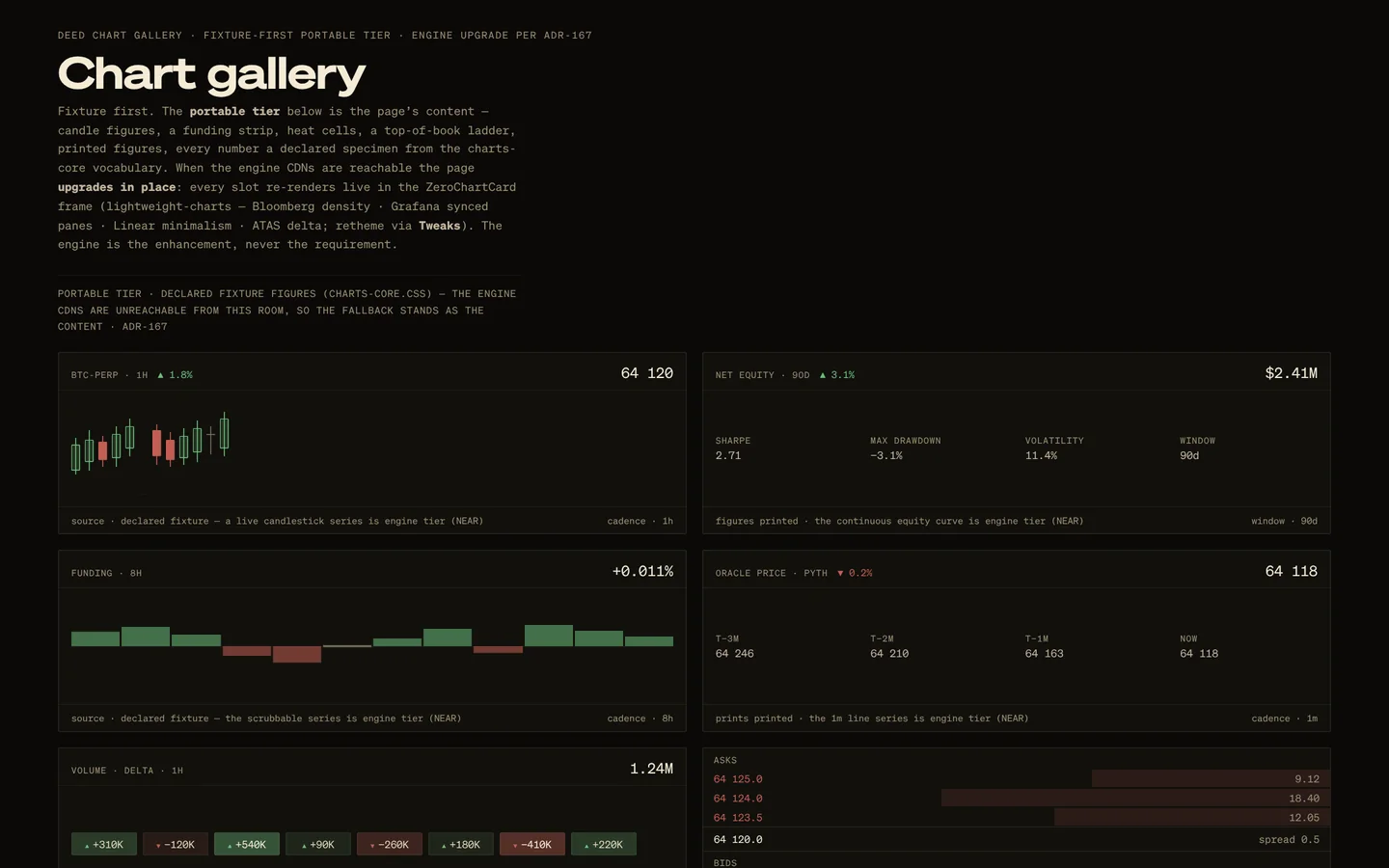
Every figure on these pages is a declared fixture, labelled as one.
For agents
Built for a stranger.
An outside agent can build with the system without reading its code: a summary written for language models, an MCP server over the catalogue and the rules, a command-line tool and a package registry.
On 31 July 2026 I gave a fresh agent an empty folder and nothing but those public docs. It built a screen that passed every check: catalogued components only, one signal, honest numbers, no raw colours. It also found nine gaps. The docs taught the rules well and the locations badly: the index said the command-line tool did not exist when it did.
Where it stands
84 out of 100, by its own scorecard.
Version 3.171 shipped on 4 August 2026, the 281st numbered release since 1.0 on 29 May. Its own scorecard gives it 84 out of 100, and 29 of the 229 components are still below its quality bar.
The checks held; the words around them drifted. The stranger test and the scorecard found the same weakness: the rules were taught well, and the documentation fell behind the code. The repository is private.
Credits
Designed and directed by me; built by Claude agents under the system’s own gates. Söhne by Klim Type Foundry, under licence.
Sources
- The Decoder: the llms.txt proposal, September 2024
- AlternativeTo: Figma’s MCP server, June 2025
- The DEED design system repository, private: its changelog, catalogue, critic, docket, gates and the stranger receipt of 31 July 2026, read on 24 October 2026
Figures are counts from the private repository as of version 3.171, 4 August 2026. The screens are the system’s own pages; every figure on them is a declared fixture.