For most of my career the work was the artefact. A screen, a logo, a flow, a page. I made it, someone shipped it, and people used the thing I made.
That is changing faster than our job titles. In 2026 agents write the landing pages, cut the campaign variants, draft the components, fill the screens with copy and propose the next version of the product. They do it in minutes, and in thousands. A brand that used to produce a few hundred artefacts a year now has agents producing them every hour, in its name.
When a machine makes the artefact, the designer’s deliverable moves up a level. It becomes the principles the artefacts are made from, and the checks that hold them.
The artefact stops being the unit of work.
A design system was meant to be components, tokens and guidelines a team could use to make consistent things. In practice it was a library and a PDF. People read the guidelines once, copied the components and drifted. Review caught some of it. Most of it shipped.
That worked because people are slow. A team of ten can only make so much off-brand work in a week. Agents remove the speed limit. If the principles live in a document only people read, the brand drifts at the speed of generation.
So the principles have to move out of the document and into the system: written so a machine can read them, measure the work against them and refuse what breaks them. A design system becomes less a library and more a set of principles that run.
Three places it runs.
I see the same shift in three places, and I have built a version of each.
The brand.
Brand principles decide what may be made in a brand’s name: colour, type, spacing, imagery, motion and voice, written as rules a machine can test.
The design system I built for DEED this year works this way. It keeps a catalogue of everything that exists, so an agent can’t invent a component that isn’t in it. Every surface is enrolled. A checker loads each one at phone, tablet and desktop widths and measures it against the system’s rules on the live page. Version numbers are bound to their sources, so a number can’t change in one place without moving where it comes from. When the checker finds a breach, the surface fails with the rule it broke.
The interesting part is what this does to taste. Taste used to live in a senior designer’s head and arrive as comments in review. Here a good part of it is written down as refusals. The accent colour appears once per screen. Small text never sits in a colour that fails contrast. Type comes from one family. An agent can still be inventive inside the principles. It can’t quietly erode them.
Here is a small version, running on this site’s own principles. Eight agents propose changes to a campaign card. Turn the principles off to see what they do without them, and watch the chip in the top bar.
Live · the brand · invented agents, this site’s real principles
degenie · campaign
Ask before you spend.
An essay on the screen a person sees before an agent moves their money.
Read the essayEssay6 min
0 applied · 0 refused
Today’s proposals
- Copy agentQueuedShorten the headline for a 390 px screenWaiting for an answer07 line length · 11 characters
········ - Promo agentQueuedAdd a second accent, violet, for the launchWaiting for an answer01 palette · one signal colour
········ - Growth agentQueuedRound every corner to 14 px so it feels friendlierWaiting for an answer08 corners · square or round
········ - Legal agentQueuedSet the disclaimer in signal at 11 pxWaiting for an answer03 signal on paper is 2.7:1 · 06 nothing under 12 px
········ - Locale agentQueuedPublish the German headlineWaiting for an answer07 line length · 24 characters
········ - Speed agentQueuedSwap Söhne for a free font to save 40 KBWaiting for an answer05 four faces, one family
········ - Social agentQueuedFill the background with signal to stop the scrollWaiting for an answer02 signal would cover 64% · the limit is 7%
········ - YouQueuedApprove square tags for data tablesWaiting for an answersigned · added to the record
········
The product.
Product rules decide what an agent may do for a person. They are the part of a product people used to meet as a confirmation dialog.
For fifteen years I designed the moment a person hands power to a machine: a flight booking, a trading terminal, a wallet’s swap, a contract approval. In each of them the person pressed the button. Agents move that decision away from the moment. You decide on Monday what an agent may do, and it acts on Thursday while you sleep.
The treasury instrument below is a small version of this. The rules are a sentence a person can read and edit. Spend up to a daily amount. Ask me before paying anyone new. Ask me for anything over a limit. Reduce risk while I’m away. A crew of agents runs a day of work under them. Most actions pass and leave a record. Unsafe ones are refused with the rule that stopped them. One exception stops the clock and asks the person, with a default and a timer. Switch to “ask me before every action” and you feel why approval screens alone don’t scale.
Live · the product · an invented crew and treasury

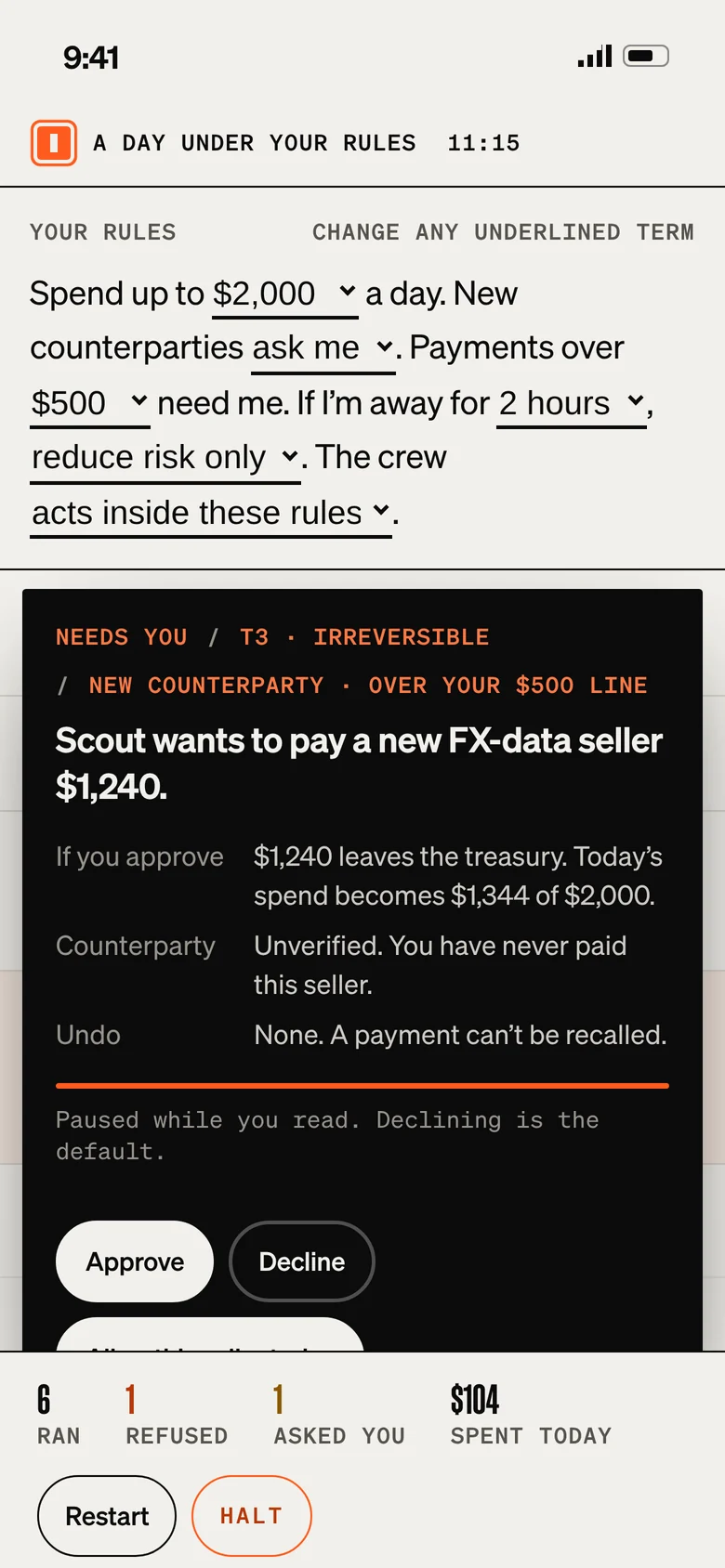
A day under your rules
Prototype · sample data09:31Your rulesChange any underlined term
Spend up to a day. New counterparties . Payments over need me. If I’m away for , . The crew .
Needs youT3 · irreversible
Waiting for your decision
- If you approve
- Counterparty
- Undo
- None. A payment can’t be recalled.
- ScoutPay the compute provider $64A backtestranr·2f21
- KeeperReconcile balances across three venuesWallet, perps venue and lending pool matchranr·3287
- ScoutPay the market-data feed $18An hour of order-book dataranr·37be
- Ran
- 3
- Refused
- 0
- Asked you
- 0
- Spent today
- $82
The company.
Operating rules decide what a company’s agents may do on its behalf. They are the newest of the three, and where most companies will feel the change first.
Inside DEED, much of the work of building the product is done by agents. Every action they take is classified by its consequence: reading a file, a change that can be undone, a change that costs money, one that is public, one that can’t be undone, and a change to the rules themselves. The low classes proceed and leave a record. The high classes wait for me. Consent for a batch of ready work is given in one sitting, so I review deliberately instead of answering a stream of prompts. There is one governed path to production, and an agent that tries another one is refused.
Below, an invented crew runs ten actions. Each lands on its rung of the ladder. The low rungs run and leave a record; the high ones wait for you, with a timer and a default of no.
None of this is exotic. It is what a careful founder already does in their head. Writing it down is what lets a company run on agents without the founder becoming the bottleneck, or the risk.
What makes a principle run.
Across the three, the same five properties separate principles that run from a style guide with a new name.
- A person can read it. In plain words, short enough to hold in mind. If the owner can’t read it, they can’t own it.
- A machine can check it. Every principle comes with a measurement. A rule with no check is a hope.
- It can refuse. When something breaks it, the system stops and says which principle. Refusal is where trust comes from. An agent that can say no is one you can trust with more.
- It leaves a record. What was proposed, under which principle, who approved it, what happened. The record is how the principles get better.
- It changes only by a signed proposal. The principles evolve through proposals that carry their evidence and a person who signs them. That gives a brand a changelog, and a changelog is what lets a living system be trusted.
A brand book was read once, by people. A brand’s principles are now read every minute, by machines.
What this does to the designer.
The craft stays. You still need an eye for type, for colour, for the exact moment a flow asks too much of someone. That eye now has a second output. Besides the artefact, it produces the principles that let other makers, human or not, do good work without you in the room.
That changes the daily work. Less drawing every state by hand, more deciding which states are allowed. Less reviewing pixels, more reviewing proposals to change the principles, with their evidence. More writing. The best designers I have worked with already did this informally. The difference now is that it has to be explicit, because the makers can’t read your mind.
It also changes what the work is worth. A screen is made once. A principle compounds. Every artefact made under it is better, for as long as it holds.
What this does to brands.
A brand used to be something people built and then defended. Now it is also something that runs. Agents write its posts, answer its customers, propose its campaigns and draft its product. Each of them acts in the brand’s name.
That raises two questions every brand will have to answer in public. What may be made in our name? And who approved what was made? The first is a matter of principles. The second is a matter of record. A brand that can answer both can let agents do more. A brand that can’t will drift, or slow down until it can.
It also raises a question of candour. People notice machine-made content, and surveys this year put hidden AI use at the top of their complaints about brands on social media. A principle can carry that rule too. Work made with agents says so, and a person signs what goes out.
Why this site checks itself.
It would be odd to argue all this on a website built the old way. So this one is built on its own principles and checks every page against them.
They are written on their own page: colour, type, layout, motion, voice, and the exceptions they allow, each with its reason. A checker runs in your browser on the page you are reading, measures it against every principle and shows the result in the top bar. It checks what I would check in a review: contrast, the one accent colour, the type, the line length, the tap targets, the alt text. When I change the site, the change goes into a public record with what it touched.
They are small principles for a small brand. The method is the one I bring to companies at a larger scale: brands, products and companies that run on agents.